Do Compression Packing Cubes Really Save Space in Luggage?
Compression packing cubes reduce bulk by squeezing out air with secondary perimeter zippers, but their true space savings depend on fabric type and packing technique.
By the Niche Picks editorsUpdated October 28, 20269 min readDrawn from our 30 research-based travel gear & luggage reviews
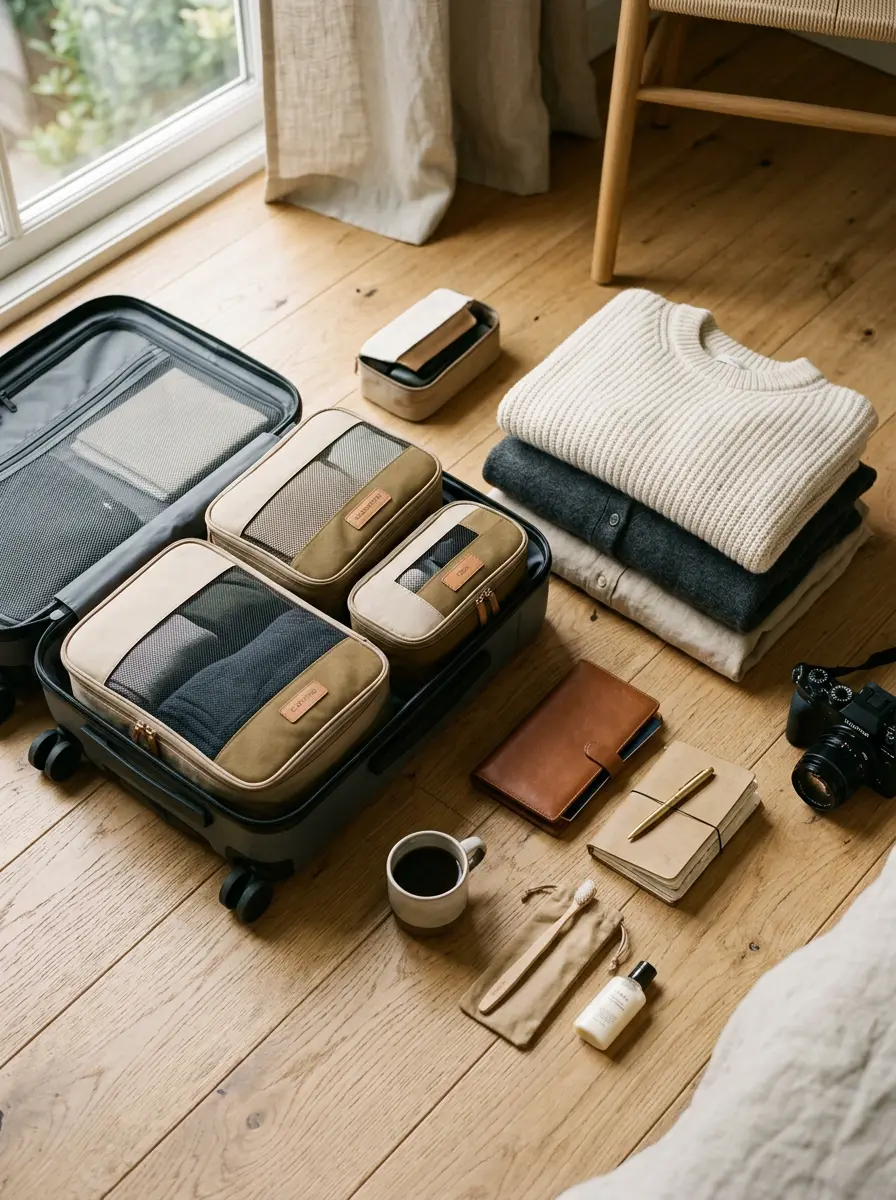
AI-generated editorial illustration; not a product or test photograph.
Short answer
Yes, compression packing cubes save noticeable physical space in luggage, reducing clothing volume by roughly 20 to 40 percent. They work by using a secondary perimeter zipper to compress soft, air-trapping garments like knitwear and t-shirts. However, dense textiles like denim compress minimally, and cubes do not reduce physical weight.
4
Product listings discussed; not hands-on tests
4/4
Discussed listings with a recorded price
$11.60–$29.98
Recorded listing price range; not a complete setup cost
Key takeaways
Secondary perimeter zippers physically flatten bulky garments by forcing trapped air out through seams and breathable mesh.
Soft, airy fabrics like fleeces, sweaters, and t-shirts yield the greatest volume reduction, whereas dense denim or leather compresses very little.
Compression cubes reduce volume but add dry fabric weight, increasing the risk of exceeding strict airline baggage weight allowances.
Overstuffing cubes transfers intense tension to perimeter zippers and seams, creating common mechanical failure points.
Standard non-compression cubes offer modular organization and layout control, but they do not actively flatten your clothing.
Products discussed in this article
Editorial scores and recorded prices are reference points, not measurements of suitability for every use. Read each review's specifications and limitations.
How do compression packing cubes actually create space?
Compression packing cubes operate on a simple mechanical principle: eliminating the dead air space trapped within woven apparel. When you fold clothing loosely into an open suitcase, air pockets between fabric layers occupy significant cubic volume. While standard travel organizers merely corral these items into rectangular bundles, compression cubes feature a dual-zipper configuration designed to actively flatten the packed contents.
The mechanism uses two separate tracks. First, you fill the main compartment and close the primary entry zipper, much like a conventional pouch. Next, you pull a secondary perimeter zipper that runs along the outer sidewall of the cube. As this perimeter slider travels around the circumference, it draws the top and bottom fabric panels toward each other, expelling air through textile seams and ventilation panels.
Unlike hermetic vacuum-seal bags that require an external suction pump or handheld vacuum, zippered compression cubes rely entirely on perimeter mechanical tension. Sets such as the BAGAIL 6-Piece Compression Set feature half-mesh construction specifically to allow air to escape freely during compression. This mechanical squeeze produces a uniform brick of clothing that measures noticeably thinner than its uncompressed state. In typical overhead rollers or duffel bags, this reduction frees up inches of vertical clearance, allowing travelers to pack extra apparel or fit bulky items into tight compartments.
However, it is crucial to recognize that compression changes geometry, not mass. The clothing becomes denser rather than smaller in total fiber content. Before planning your next flight, reviewing our carry-on luggage size guide ensures your denser luggage footprint stays within cabin parameters.
Compression cubes vs. regular packing cubes: what is the real difference?
The fundamental distinction between standard organizers and compression cubes comes down to hardware architecture and volume displacement. Standard models, such as the Amazon Essentials 4-Piece Medium Set, provide structured compartmentalization. Built from lightweight polyester with mesh tops, each medium organizer yields roughly 610 cubic inches of packing capacity without any mechanical mechanism to flatten the interior contents. They serve to prevent shifting, keep clean clothes segregated from laundry, and streamline packing layouts.
In contrast, dedicated compression organizers add a reinforced perimeter zipper that physically reduces the cube's exterior depth. For example, the 9-Piece Compression Travel Set includes four graduated clothing organizers that use an outer perimeter track to consolidate bulk mechanically. While regular cubes maintain a fixed height—often around 3 inches—compression models can expand to roughly 4.3 to 4.5 inches during loading and squeeze down to a consolidated slab once fully closed.
This functional divergence directly influences how you organize your luggage. Standard packing organizers excel when you want to avoid fabric creasing or simply want modular blocks to slot neatly inside rolling cases like the Freeform Hardside Carry-On. Compression cubes, on the other hand, are designed specifically for maximum volume recovery. The trade-off lies in weight and complexity: compression systems require durable perimeter stitching and heavier zipper coils, adding slightly more baseline tare weight to your luggage kit. If you are debating which style suits your personal routine, our comprehensive breakdown on whether packing cubes are worth it explores the day-to-day practicalities.
Which clothing items compress effectively (and which do not)?
Compression packing cubes do not compress all textiles equally. The amount of space you reclaim depends directly on the loft, weave, and density of the garments inside.
High-loft knitwear and fleece: Items like wool sweaters, fleece jackets, synthetic down vests, and fluffy loungewear contain abundant trapped air. These garments compress dramatically, often shrinking to less than half their initial uncompressed depth.
Cotton basics and athletic wear: T-shirts, gym shorts, socks, and synthetic underwear compress reliably. While their weave is tighter than fleece, folding them neatly and drawing the secondary track eliminates significant airspace between folds.
Dense textiles: Heavy raw denim, structured canvas trousers, and stiff twill work pants contain minimal trapped air. Their rigid textile fibers resist compression, causing the cube to bulge laterally rather than flatten.
Tailored garments: Dress shirts, blazers, and linen items can theoretically be compressed, but the compressive pressure forces sharp, stubborn creases into delicate fibers, requiring extensive pressing upon arrival.
Sets like the OlarHike 10-Piece Compression System supply multiple pouch sizes ranging from small to extra-large, allowing you to segregate compressible activewear from rigid apparel. Putting denim in a compression cube mainly provides modular containment, while packing knitwear into that same cube yields significant spatial savings.
What are the hidden trade-offs: weight creep and airline carry-on limits?
While compression cubes undeniably free up visible cubic inches inside your bag, they introduce a distinct practical liability: weight creep. By removing the visual feedback of a bulging suitcase, compression organizers make it remarkably easy to overpack. A standard 22-inch carry-on roller generally accommodates 34 to 39 liters of cargo. Packing that space with uncompressed clothing usually creates a natural stopping point before the bag exceeds domestic airline limits.
When you consolidate clothing into dense, compressed bricks, you can easily load 50 liters worth of apparel into a 34-liter footprint. However, clothing density increases your total baggage weight. Many international and budget carriers enforce strict carry-on weight caps ranging from 7 to 10 kilograms (15 to 22 pounds). A bag that closes effortlessly with compression cubes can easily register well above those thresholds at the boarding gate. Furthermore, the organizers themselves add base mass; a complete multi-piece system like the 10-piece OlarHike kit weighs 1.9 pounds empty, while the 9-piece Veken bundle registers at 1.5 pounds.
Another critical consideration involves shell expansion. If you compress cubes aggressively and pack a hard-sided suitcase to maximum capacity, the internal outward pressure can push against the exterior shell, bowing zipper lines outward. If your roller already measures near maximum cabin thresholds, that outward bow can cause it to fail strict airport sizer boxes. Reviewing common travel gear mistakes can help you avoid these gate-check surprises.
Where do compression cubes fail: zippers, seams, and materials?
Because compression packing cubes operate under constant outward mechanical tension, their structural failure modes differ substantially from ordinary duffel bags or standard pouches. The perimeter compression zipper bears the brunt of this physical strain. When a traveler forces the outer track closed over an overstuffed compartment, the slider teeth undergo significant lateral shear.
In budget organizer sets, such as the BAGAIL 6-Piece Set built with 320-denier polyester, the fabric specifies a load capacity of roughly 10 pounds per unit. Exceeding reasonable capacity risks seam separation along high-stress points, particularly where solid synthetic fabric transitions into open mesh windows. While mesh inserts are vital for venting air during closure, perforated weaves exhibit lower tensile tear thresholds than solid ripstop or high-density woven nylon.
Another frequent issue is fabric snagging along the perimeter zipper track. Because compression requires drawing two opposing edges together against an expanding pile of clothing, loose inner lining or garment hems frequently catch in the moving slider. Forcing a jammed slider forward under high tension can strip zipper coil teeth, permanently ruining the cube's compression function.
To ensure reasonable longevity, examine the manufacturer's stitching density and zipper hardware before traveling. For budget-conscious shoppers evaluating total gear costs, our travel gear budget planner helps balance organizer investments against durable luggage pieces.
How should you pack and zip compression cubes to prevent damage?
Achieving maximum space reduction without stripping zipper teeth or blowing out side seams requires deliberate technique rather than brute force. Rushing the compression process is the primary cause of hardware jams and torn seam allowances.
Begin by folding or rolling your clothing to match the exact rectangular footprint of the cube. Layer items evenly from edge to edge rather than mounding garments in the center. An uneven mound creates a severe outward bulge that concentrates excessive stress onto a single point of the perimeter track.
Once filled, close the primary top entry zipper completely. Before touching the outer compression zipper, use your hands to apply firm, downward pressure across the center of the cube. Kneeling or pressing your palm flat against the top panel manually expels the trapped air through the fabric weave and mesh panels, pre-compressing the garments.
Next, gently guide the perimeter compression slider around the edges. As you pull the slider, slide one finger along the inside of the track just ahead of the slider head. This crucial step holds the internal lining and garment edges away from the zipper teeth, eliminating snag hazards. If the slider encounters heavy resistance, stop pulling immediately. Apply renewed downward hand pressure on that corner to relieve tension, then continue drawing the slider closed. This disciplined procedure preserves coil teeth and ensures your cubes deliver reliable volume reduction trip after trip.
Who actually benefits most from compression packing cubes?
Compression packing cubes are not universally necessary for every type of travel, but they offer decisive advantages for specific packing scenarios.
Travelers relying strictly on carry-on luggage or single-backpack transit benefit the most. If you travel with an overhead backpack or a compact 20- to 22-inch roller, interior cubic volume is your most restricted resource. Consolidating four days of shirts, base layers, and socks into two flat compression blocks allows you to fit shoes, tech pouches, and toiletries without needing to expand your suitcase or check a bag at the counter.
Conversely, travelers who frequently pack tailored business wear, structured suits, or thick wool trousers will find compression cubes counterproductive. The mechanical clamping action inevitably introduces deep creases into crisp fabrics, and rigid fibers resist compression anyway. Furthermore, if you routinely travel on airlines with aggressive cabin weight enforcement, standard non-compression organizers like the Amazon Essentials 4-Piece Set offer modular organization without tempting you to exceed carry-on weight limits.
For general vacationers, cruise passengers, and multi-destination backpackers, compression cubes remain an effective, low-cost method to squeeze maximum clothing into minimum luggage volume. To explore more packing solutions, check our complete travel gear buyer's guide and discover our top recommendations in the best carry-on luggage roundup.
1Fold or roll garments flat to match the cube's length and width dimensions.
2Stack items evenly inside the main compartment to avoid a bulging center hump.
3Zip the primary top compartment closed over the garments.
4Press down firmly on the top panel with both hands to vent trapped air through the mesh.
5Locate the secondary perimeter compression zipper pull.
6Pull the perimeter slider around the cube, placing your finger behind the track to prevent fabric snags.
7Pack the flattened cube into your luggage, placing heavier cubes along the wheel base.
Quick checklist
Check your airline's maximum carry-on weight limit, not just dimensional requirements.
Sort garments by compressibility: place knitwear and synthetics in compression cubes, and fold stiff denim separately.
Fold apparel flat to match the rectangular footprint of the cube rather than creating an uneven center mound.
Close the main top zipper completely before engaging the perimeter compression track.
Manually press down on the center panel to expel air prior to pulling the compression slider.
Inspect perimeter seams for tension stress and avoid forcing jammed sliders.
Frequently asked questions
Do compression packing cubes cause clothes to wrinkle?
Yes, compression cubes can cause more wrinkling than standard packing cubes. Because the perimeter zipper forces fabric layers together under high pressure, any existing folds become tightly creased. To minimize deep wrinkles, fold garments flat without bunched seams, or reserve compression cubes for knitwear, casual t-shirts, and athletic synthetics.
Can compression packing cubes damage my clothing?
Compression cubes will not harm standard synthetic or cotton knits, but delicate items like underwire bras, structured hats, or tailored jackets should never be compressed. Additionally, forcing zippers closed over packed garments risks catching delicate fabric in the moving metal or nylon teeth, which can cause snags or fabric tears.
How much luggage space do compression cubes actually save?
On average, compression cubes reduce clothing bulk by roughly 20 to 40 percent. The exact reduction depends heavily on your wardrobe: puffy fleeces and knit sweaters compress significantly, while dense fabrics like denim or linen experience minimal thickness reduction due to their tight structural weave.
Are compression cubes better than vacuum space-saver bags?
Compression cubes are generally more practical for regular travel than vacuum bags. While vacuum bags achieve higher volume reduction by removing all air, they require a vacuum pump or manual rolling, tend to puncture easily, and leave clothing severely wrinkled. Compression cubes require no tools and are built for quick daily hotel repacking.
Do compression cubes make luggage heavier?
The cubes themselves add very little base weight—typically between 1.5 and 1.9 pounds for an entire multi-piece set. However, because they allow you to pack significantly more clothing into the same suitcase volume, travelers often end up with a noticeably heavier bag that can exceed airline limits.
Amazon links are affiliate links; we may earn a commission at no cost to you.
Sources and limits
This page summarizes our research reviews of Amazon listings, listed specifications and captured buyer ratings. It is not a hands-on test. Scores are editorial assessments, not measured performance; prices are recorded snapshots and may change. A category can include both main products and accessories, so its overall price range is not the cost of a complete setup.
Most recent product record update: September 29, 2026. Individual records may be older; this is not a verification date for every claim.
Choose the product type first. These groups require a match in the listing title; an import search term alone is not enough. Scores rank our recorded research assessments within each group, not independently measured performance.
Values are shown as recorded, without unit conversions or inferred compatibility. Not recorded means unknown, not absent. Prices are snapshots, not current offers. Editorial scores are research judgments, not lab results. Amazon links are affiliate links.
Before treating a comparison as complete
Which details are still unknown?
A specification appearing in a listing is not independent verification. These counts show which shortlisted records contain the same field; a blank record does not mean the product lacks the feature.
Included Components
Recorded for 2 of 2 shortlisted models
Present in every shortlisted record. Check units, exact variants and the current manufacturer documentation before relying on it.
Item Dimensions L x W x H
Recorded for 2 of 2 shortlisted models
Present in every shortlisted record. Check units, exact variants and the current manufacturer documentation before relying on it.
Item Weight
Recorded for 2 of 2 shortlisted models
Present in every shortlisted record. Check units, exact variants and the current manufacturer documentation before relying on it.
Load Capacity
Recorded for 2 of 2 shortlisted models
Present in every shortlisted record. Check units, exact variants and the current manufacturer documentation before relying on it.
Size
Recorded for 2 of 2 shortlisted models
Present in every shortlisted record. Check units, exact variants and the current manufacturer documentation before relying on it.
Closure Type
Recorded for 2 of 2 shortlisted models
Present in every shortlisted record. Check units, exact variants and the current manufacturer documentation before relying on it.
Check the airline's carry-on limits including wheels and handles.
Compare shell construction, repairability and warranty; material names alone do not guarantee impact resistance or a specific failure mode.
Serviceable wheels matter more than shell branding.
If a specification, certification or compatibility detail is absent, mark it as unknown and ask the seller or manufacturer. Do not substitute a star rating, an editorial score or a different model's specification.