Protect your timepieces with our guide to display and winder boxes, balancing storage security, case clearance, and long-term mechanical movement wear.
By the Niche Picks editorsUpdated October 10, 20269 min readDrawn from our 30 research-based watches & watch accessories reviews
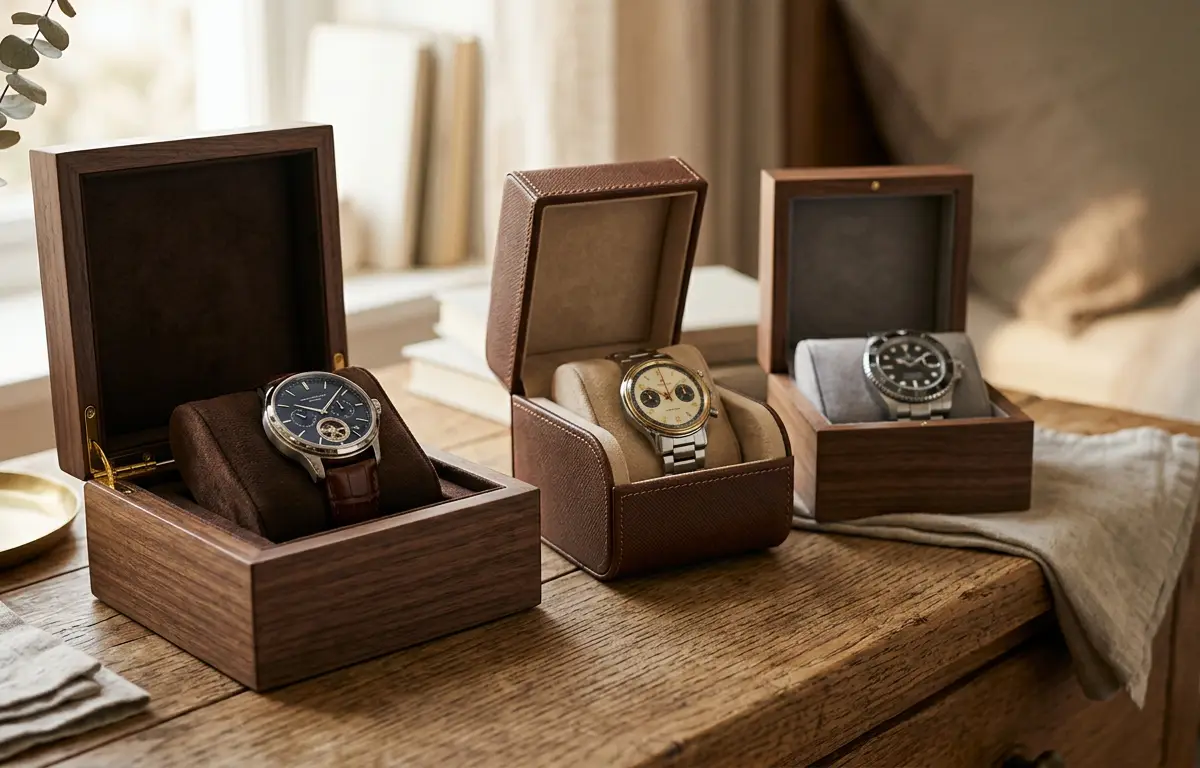
AI-generated editorial illustration; not a product or test photograph.
Short answer
The best watch box protects dials from dust, isolates cases to prevent metal-on-metal scratches, and safely accommodates your collection's case diameters. If choosing an automated winder box, look for quiet motor operation, gentle rotational rest cycles, and secure pillows to prevent unnecessary mechanical wear on your automatic calibers.
3
Product listings discussed; not hands-on tests
3/3
Discussed listings with a recorded price
$21.99–$33.79
Recorded listing price range; not a complete setup cost
Key takeaways
Motorized watch boxes keep perpetual or calendar complications primed, but running them constantly accelerates movement service intervals.
Adequate slot clearance is critical; cases over 44mm require generous spacing to prevent crown-to-case impact during storage.
Compressible velvet or padded pillows protect case flanks and casebacks from hairline scratches far better than rigid plastic holders.
Acrylic viewing windows provide clear dial visibility but scratch far more easily than sapphire crystal watch faces.
Movement service intervals remain the defining long-term ownership cost of any mechanical timepiece in your rotation.
Products discussed in this article
Editorial scores and recorded prices are reference points, not measurements of suitability for every use. Read each review's specifications and limitations.
Automatic Single Watch Winder Box, Quiet Motor, LED7.2
Watch Winder for Automatic Watches, Double Automatic7.2
Watch Winder for Automatic Watches: Automatic Single6.8
Recorded price (USD)
Automatic Single Watch Winder Box, Quiet Motor, LED29.55 USD
Watch Winder for Automatic Watches, Double Automatic33.79 USD
Watch Winder for Automatic Watches: Automatic Single21.99 USD
Motorized Watch Box Comparison
Product
Price
Capacity
Power Interface
Interior Material
SONGMICS Single Winder
$29.55
1 Watch
USB-C
Velvet
Mcbazel Double Winder
$33.79
2 Watches
USB Cable
Velvet
Single Winder Box
$21.99
1 Watch
USB-C / Battery
Padded / Acrylic
How do you choose the best watch box for your collection?
Selecting the right storage for your timepieces comes down to balancing physical defense, accessibility, and the mechanical requirements of your collection. While traditional static collector cases simply offer inert compartments to keep dust away, automated watch boxes incorporate motorized rotors to keep self-winding calibers energized. If your collection consists mostly of quartz daily drivers, a static box with dedicated display slots is all you require. However, if you rotate between pieces featuring calendar complications, an active storage unit prevents the inconvenience of continuous manual resetting.
Regardless of whether a box is motorized or stationary, interior architecture matters immensely. The best boxes utilize plush velvet or microfiber linings that shield polished case flanks from friction. Hard contact surfaces inside a display compartment will quickly introduce micro-swirls to stainless steel or gold-plated finishes. You can read more about safeguarding fine finishes in our Watches & watch accessories buyer's guide.
Cushion geometry is another critical consideration. Stiff, non-yielding pillows can stretch tailored leather straps or place excessive strain on fixed steel bracelets sized for smaller wrists. Conversely, loose cushions allow heavy dive cases to tilt forward, potentially banging their crystals against display lids. Prioritize boxes with compressible cushions that seat securely into individual recessed bays. Before purchasing, evaluate your collection's physical dimensions alongside our comprehensive Watches & watch accessories FAQ to avoid common storage pitfalls.
What makes the Songmics Single Watch Winder Box a balanced choice?
The SONGMICS UJWB030B01 offers a compact, single-watch tabletop footprint wrapped in black synthetic PU leather. Designed for individual daily wearers or collectors needing to keep one primary automatic piece primed, it pairs clean external lines with functional display utility. The interior features a soft velvet lining that cushions the case and bracelet, preventing scratches during insertion and removal. A front-facing viewing window provides optical access, and an integrated key lock provides light closure retention to keep curious hands away from your timepiece.
Under the hood, the unit relies on a USB-C power interface, giving it modern power flexibility from conventional wall adapters or desktop ports. Operation spans four distinct pre-configured modes, including clockwise, counterclockwise, and two alternating cycles structured with intermittent pause intervals. These rest periods are essential because continuous, unpaused rotation places unnecessary mechanical fatigue on mainspring slip bridles. However, the manufacturer does not specify exact turns-per-day figures, meaning users should monitor how their specific automatic caliber maintains amplitude on each setting.
At a listed price of $29.55, backed by a 4.7 out of 5 rating across more than 3,100 consumer reviews, this single box represents an accessible storage and winding solution. While the exterior relies on synthetic composite leather rather than solid hardwood cabinetry, the seams and hardware are cleanly executed. It eliminates the friction of hand-winding complicated watches each morning without claiming excessive dresser space. For a detailed breakdown of this model, consult our review of Automatic Single Watch Winder Box, Quiet Motor, LED Light, Lock.
Can a dual-slot box handle two larger sports watches simultaneously?
When storing multiple timepieces in a shared motorized cradle, case clearance becomes the primary engineering challenge. The Mcbazel Double Automatic Watch Winder Box tackles this format at an entry price of $33.79, offering dual watch capacity wrapped in black faux leather with a transparent acrylic display window. The interior is lined in soft velvet, and its removable outer cushion sleeves accommodate strap circumferences between 175 mm and 195 mm, making it adaptable to varied wrist sizes.
Accommodating modern sports watches requires strict adherence to physical dimensions. The manufacturer notes that the cradle handles individual cases up to 47 mm in diameter and 28 mm in thickness. However, there is an essential physical limitation: watches with a combined case diameter exceeding 58 mm will collide inside the dual cradle during rotation. Collectors pairing two oversized divers or wide pilot watches will find the bays too cramped, risking bezel-to-bezel contact. You should verify your watch diameters across our comparison tools before loading wider tool watches into shared dual-slot rotors.
Operational performance is managed by a quiet Japanese motor powering two rotational cycle options: Mode B alternates two minutes clockwise and two minutes counterclockwise with six-minute rest pauses, while Mode L extends rest intervals to 18 minutes. Turns per day range between 970 and 2,430 across these modes. While both slots share a single drive axis without independent speed controls, the unit offers practical multi-watch convenience on a minimal budget. Learn more in our review of Watch Winder for Automatic Watches, Double Automat.
How does an entry-level carbon-look single box perform on a budget?
At an accessible price point of $21.99, the Automatic Single Watch Winder Box targets collectors who want basic rotational display capabilities without unnecessary expense. The chassis utilizes medium-density fiberboard finished with a carbon-fiber patterned leatherette exterior, sealed with an acrylic viewing window and a magnetic lid closure. The compact design occupies minimal space on a nightstand or desk, and dual power options—via USB-C or an internal battery compartment—allow neat, cord-free placement.
Inside, an adjustable pillow compresses to hold bracelets and straps securely within the rotating bay. The operational sequence is fixed: two minutes of clockwise rotation, six minutes of rest, two minutes of counterclockwise rotation, and six minutes of rest. While this bi-directional schedule suits most modern calibers with bilateral winding weights, watches featuring unidirectional winding mechanisms will simply free-wheel during half the program. Owners should confirm whether their watch caliber winds clockwise, counterclockwise, or bi-directionally before relying on a fixed-program box.
The acrylic lid provides clear visual presentation, but users should note that acrylic glass scratches far more readily than the sapphire crystals on quality tool watches. Avoid wiping the clear panel with coarse dry cloths to prevent surface hazing. For collectors seeking baseline desktop presentation on a modest budget, this unit delivers straightforward function. Read our thorough review of Watch Winder for Automatic Watches: Automatic Sing for additional mechanical specifications.
How do motorized storage boxes impact movement service intervals?
A critical truth of horology is that movement service intervals represent the real long-term cost of owning mechanical timepieces. An automatic watch operates via a weighted rotor that tensions a coiled mainspring as you move. When you place a timepiece inside a motorized winder box, its internal gear train, escapement, and rotor bearings continue running around the clock. Over five to seven years, continuous mechanical motion depletes synthetic lubricants and causes microscopic metal friction, bringing forward the need for professional overhaul.
Routine disassembly, cleaning, re-lubrication, and regulation by an independent watchmaker typically start between $150 and $250 for basic three-hand calibers, and can run significantly higher for complicated chronographs. If your watch retails under $100—such as entry-level mechanical divers—a single routine overhaul easily exceeds the replacement value of the entire piece. For these watches, keeping them running continuously in an active box may shorten their practical operating life.
Active boxes make genuine economic and ergonomic sense when housing timepieces with complex calendar complications, moon phases, or perpetual date mechanisms that require tedious realignment after power reserves deplete. For basic three-hand models with simple date windows, allowing the power reserve to run down when unworn is mechanically harmless. Learn more about caliber care and maintenance in our guide to the best automatic watches and review our breakdown of mistakes to avoid when storing mechanical timepieces.
Why do cushion dimensions and case clearance matter so much?
When evaluating watch box compartments, exterior cabinet dimensions tell only half the story. The internal clearance—specifically slot width, compartment depth, and cushion circumference—determines whether your watches remain pristine or suffer avoidable cosmetic wear. Many low-profile boxes lack the vertical clearance necessary for chunky tool watches, causing the inside of the lid to press directly against the watch crystal upon closing.
While a sapphire crystal is worth it on anything you wear daily due to its superior scratch resistance, mineral glass and acrylic lenses are soft enough to pick up abrasions from repeated contact with box lids or rigid dividers. Similarly, lateral clearance between compartments is paramount. If two watch slots are spaced too closely, cases wider than 42mm will bump crowns against neighboring bezels whenever the box is moved or rotated.
Cushion sizing must also match your wrist circumference. Fixed, oversized pillows force owners with smaller wrists (under 6.5 inches) to stretch their straps or leave bracelet clasps unhooked, allowing watches to wobble inside the cradle. Ideal box designs utilize stepped cushions or flexible foam cores that compress evenly without exerting outward tension on delicate leather strap stitching or bracelet pins. Before choosing a box, measure the total diameter of your largest watch including its crown to verify that compartment dividers provide at least 3 to 5 millimeters of protective clearance.
Should you buy an active winder box or a traditional static display case?
Deciding between a motorized winder box and a static display case depends entirely on what movements power your collection and how frequently you swap watches. A static, multi-compartment watch box is the superior choice for diverse collections containing quartz watches, solar-powered pieces, and manual-wind timepieces. Static boxes offer broader layout flexibility, often featuring dedicated pull-out drawers for strap storage, spring bar tools, and extra links, all without electrical cords or motor hum.
Conversely, an active winder box is a specialized tool designed specifically for automatic calibers. It keeps the mainspring wound so the watch is ready to strap on at any moment without setting the time. However, winder boxes carry distinct limitations:
They require electrical power via USB or batteries, restricting where you can place the cabinet.
Sub-fifty-dollar motors can develop noticeable mechanical hum over months of continuous cycling.
Rotating mechanisms generate internal wear on running movement components.
Multi-slot winders rarely provide auxiliary storage for loose straps, clasps, or sizing tools.
If you own only one or two automatic watches with standard quickset dates, a static box paired with an occasional manual wind is often the most cost-effective and mechanically gentle approach. For readers managing multi-watch collections, explore our overview of the all Watches & watch accessories reviews to plan an optimal storage setup for your budget.
Quick checklist
Measure the case diameter including the crown for your largest watch.
Verify that cushion circumference compresses comfortably to your wrist size.
Ensure vertical lid clearance is sufficient to prevent crystal contact on tall watches.
Confirm whether your automatic watch caliber requires clockwise, counterclockwise, or bidirectional winding.
Check whether the box operates on standard USB-C or requires proprietary adapters.
Choose soft velvet or plush microfiber linings over bare wood or hard synthetic trims.
Factor in future movement service costs before running budget automatics continuously on winders.
Frequently asked questions
Can keeping a watch in a motorized box damage the movement?
Modern automatic movements feature a slipping bridle that prevents overwinding, so a winder will not snap the mainspring. However, running a watch continuously causes constant friction across gear trains and balance assemblies, advancing the need for routine movement lubrication and servicing.
What is the difference between a watch winder and a watch box?
A standard watch box provides stationary display slots and cushioned pillows to keep watches organized, dust-free, and safe from surface scratches. A watch winder box incorporates motorized rotating cradles that gently spin automatic watches to keep their mainsprings tensioned when not worn.
Can I store battery-powered quartz watches in a winder box?
You can physically store a quartz watch in a winder box, but the rotation provides zero functional benefit. Quartz movements rely on battery cells rather than kinetic rotor motion, so they only need stationary storage in a dust-free display compartment.
How much vertical clearance does a watch box need?
Most standard dress watches measure under 11mm thick, but dive watches and automatic chronographs routinely reach 14mm to 16mm in thickness. Ensure your watch box provides at least 20mm to 25mm of clearance above the cushion to avoid lid friction.
Why do watch cushions stretch small watch bracelets?
Many budget watch boxes utilize dense, rigid plastic cushions with minimal foam padding. If your bracelet is sized for a wrist under 6.5 inches, forcing it around an inflexible cushion can stretch metal pins and strain leather strap stitch lines.
Amazon links are affiliate links; we may earn a commission at no cost to you.
Sources and limits
This page summarizes our research reviews of Amazon listings, listed specifications and captured buyer ratings. It is not a hands-on test. Scores are editorial assessments, not measured performance; prices are recorded snapshots and may change. A category can include both main products and accessories, so its overall price range is not the cost of a complete setup.
Most recent product record update: September 15, 2026. Individual records may be older; this is not a verification date for every claim.
Compare the same kind of watches & watch accessories
Choose the product type first. These groups require a match in the listing title; an import search term alone is not enough. Scores rank our recorded research assessments within each group, not independently measured performance.
Movement service intervals are the real long-term cost.
Lug width, not brand, determines strap compatibility.
Sapphire crystal is worth it on anything you wear daily.
If a specification, certification or compatibility detail is absent, mark it as unknown and ask the seller or manufacturer. Do not substitute a star rating, an editorial score or a different model's specification.


 Automatic Single Watch Winder Box, Quiet Motor, LED Light, Lock