 URUQ 8 Pods Hydroponics Growing System with LED Grow Light - Black
Recorded price: $49.99 · Editorial score: 7.4/10
- Included Components
- Hydroponics Growing System
- Item Weight
- 1.65 kg
- Reason to pause
- Small water volume requires frequent top-offs
Discover the best indoor hydroponic garden systems for your kitchen counter, evaluated by reservoir capacity, pod spacing, automated pumps, and light profiles.
By the Niche Picks editorsUpdated October 10, 202610 min readDrawn from our 30 research-based indoor gardening & hydroponics reviews
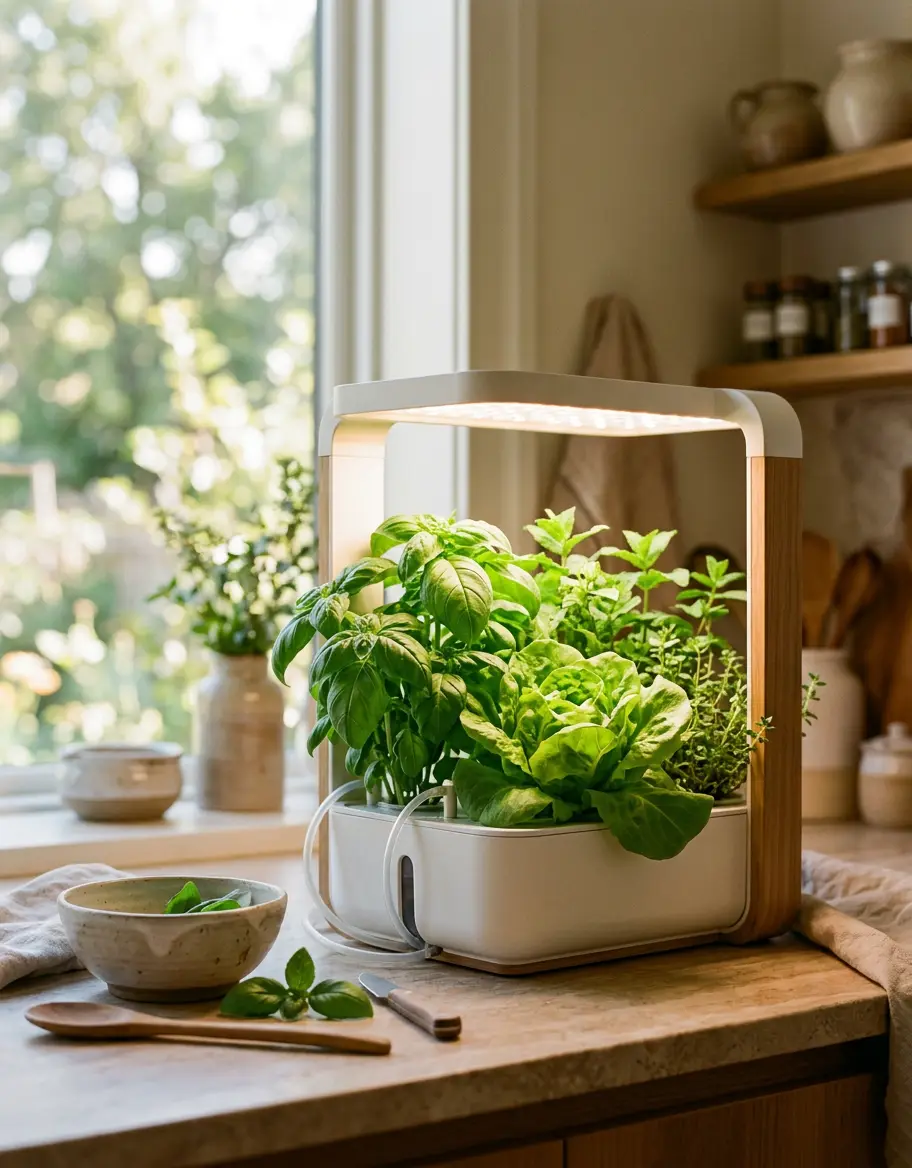
The best indoor hydroponic garden for hands-off maintenance is the LetPot LPH-SE 12-Pod system ($97.17), featuring a massive 5.5-liter reservoir, app control, and a 30-inch light mast. For tight budgets or smaller spaces, the URUQ 8-Pod system ($49.99) delivers great value by leaving more room between seedlings, while the Ahopegarden 12-Pod model ($69.99) offers onboard LCD tracking.
Editorial scores and recorded prices are reference points, not measurements of suitability for every use. Read each review's specifications and limitations.
 LETPOT LPH-SE Hydroponics Growing System, 12 Pods Smart Herb Garden Kit Indoor, Indoor Garden, APP & WiFi Controlled, with 24W Growing LED, 5.5L Water Tank, Pump System, Automatic Timer4.5$97.17Our score 8/10Best for Low-maintenance indoor herb and salad gardens
 Ahopegarden Hydroponics Growing System Kit: 12 Pods with LCD Control Panel4.5$69.99Our score 7/10Best for Countertop gardeners wanting clear status displays
 Ahopegarden Indoor Garden Hydroponics Growing System: 10 Pods Kit with LED4.5$65.99Our score 7.4/10Best for Countertop culinary herbs and small leafy greensURUQ 8 Pods Hydroponics Growing System with LED Grow Light - Black4.5$49.99Our score 7.4/10Best for Small-footprint beginners testing countertop hydroponics
| Product | Price | Capacity | Pod Count | Light Power | Max Height |
|---|---|---|---|---|---|
| LetPot LPH-SE 12-Pod | $97.17 | 5.5 liters | 12 pods | 24 watts | 30 inches |
| Ahopegarden 12-Pod LCD | $69.99 | 5.0 liters | 12 pods | Not specified | 17 inches |
| Ahopegarden 10-Pod | $65.99 | 3.0 liters | 10 pods | Not specified | 14.5 inches |
| URUQ 8-Pod System | $49.99 | 3.0 liters | 8 pods | 24 watts | 21 inches |
Selecting the best indoor hydroponic garden comes down to understanding the relationship between lighting, fluid capacity, and physical plant spacing. In soil-free indoor cultivation, plants rely completely on the water reservoir for both hydration and dissolved mineral nutrition. When browsing our Indoor gardening & hydroponics reviews, the most critical baseline rule to remember is that reservoir size sets how often you are tied to the system.
A compact 3-liter water tank works adequately for young seedlings, but as leafy greens and herbs enter peak vegetative stages, transpiration rates soar. Under typical home humidity, a dense canopy can drain small reservoirs in just a couple of days, turning a supposedly automated setup into daily chore work. Stepping up to larger capacities, like 5 or 5.5 liters, creates an essential buffer that lets you leave home for long weekends without risking root desiccation.
Lighting requires equally careful evaluation. Modern countertop systems utilize integrated light-emitting diode hoods designed to replicate the solar spectrum. We strongly favor full-spectrum white lighting over dated 'blurple' (blue and red combination) lights for units placed on kitchen counters or side tables. White daylight profiles allow natural visual inspection of foliage for deficiencies or pests and integrate seamlessly into living areas without causing ocular fatigue.
Finally, mechanical root aeration separates high-performing hydroponic boxes from stagnant water vessels. Integrated submersible pumps operating on preprogrammed timers circulate dissolved oxygen directly across root zones. Without steady aeration, root systems risk anaerobic rot, stunting growth and ruining herb harvests.
For home growers seeking maximum automation and minimal maintenance, the LetPot LPH-SE 12-Pod System is our top recommendation at $97.17. Its standout engineering choice is a generous 5.5-liter fluid tank, which holds substantially more water than conventional 2- to 3-liter countertop gardens. This extra volume significantly cuts down refill intervals, ensuring that mature, thirsty plants remain fully hydrated even if you step away for days.
The physical build of the LetPot LPH-SE combines a stainless steel exterior trim with a resin inner tank liner. This dual-wall design provides excellent structural rigidity and root thermal insulation while keeping the chassis easy to sanitize between plantings. Over the deck, an adjustable light post extends up to an impressive 30 inches—nearly double the vertical clearance offered by entry-level competitors. This additional height gives tall herbs like Thai basil or dill ample room to thrive before foliage reaches the diode housing.
Illumination is driven by a 24-watt full-spectrum overhead array with customizable vegetative and blooming modes. While the manufacturer does not publish exact PPFD (photosynthetic photon flux density) maps across canopy levels, the 24-watt output handles common herbs and leafy greens with ease. Connectivity is handled through Wi-Fi and a smartphone app, enabling remote scheduling adjustments and water cycle tweaks from anywhere.
Included in the box are 12 net baskets, sponges, germination domes, and a starter pair of A&B liquid plant nutrients. Backed by a 4.5-star score across over 1,700 reviews, the LetPot LPH-SE justifies its price tag by solving the two most frequent user complaints in countertop hydroponics: cramped vertical clearances and shallow reservoirs.
Read the reviews: LETPOT LPH-SE Hydroponics Growing System, 12 Pods
If you prefer comprehensive tracking without managing another smartphone application, the Ahopegarden 12-Pod Hydroponic System ($69.99) delivers a capable middle ground. Centered around a digital LCD interface, this countertop kit displays the current day count, lighting modes, and operational parameters directly on the front panel, keeping essential status metrics visible at a glance.
Underneath the deck sits a deep 5-liter fluid reservoir, providing plenty of volume to buffer nutrient solution and reduce refills compared to base 3-liter systems. To maintain healthy root oxygen levels, an internal submersible pump cycles automatically on a 30-minute interval pattern. This intermittent circulation aerates the solution consistently without creating annoying acoustic hums on your kitchen counter.
The overhead hood adjusts vertically up to 17 inches, featuring full-spectrum white illumination that avoids distracting pink or magenta diodes. Dual operational modes include a dedicated 22-hour flowering setting alongside standard vegetative cycles, delivering continuous output for diverse crops. However, because twelve planting sites are arrayed across an 18-by-9-inch plastic footprint, foliage crowding can become an issue once multiple plants branch out.
Ahopegarden includes 12 planting baskets, 12 grow sponges, 13 seedling covers, six hole covers (to block algae growth over unused sites), and an initial set of A&B concentrated nutrients. For users seeking a balance between a large water volume and an integrated digital dashboard, this model offers dependable execution without relying on wireless app connectivity. For more context on system designs, explore our guide to choosing a hydroponic growing system.
Read the reviews: Ahopegarden Hydroponics Growing System Kit: 12 Pods
One of the most persistent operational hurdles with entry-level hydroponic gardens is canopy congestion. Countertop units frequently crowd 10 to 12 pod openings into small frames, causing fast-growing greens to choke out adjacent seedlings. The URUQ 8-Pod Hydroponic System directly addresses this problem by trimming the deck capacity to eight well-spaced sites for an accessible price of $49.99.
Weighing 1.65 kilograms, the URUQ features a lightweight thermoplastic body and an internal lining incorporating reflective PET Mylar. A clever engineering highlight is the fully detachable light post, which extends up to 21 inches and can be separated entirely from the basin. This prevents delicate electrical plugs from getting wet when you rinse or scrub the water tank during seasonal cleanouts. The hood can also tilt, allowing you to angle illumination toward lagging plants.
The 3-liter water capacity is suitable for starting seeds and sustaining a small personal salad or herb garden. A quiet submersible pump rated below 20 decibels runs on an automated 30-minute loop, aerating root systems and preventing stagnant film buildup. The overhead array draws 24 watts of wall power, casting a daylight-mimicking white light that keeps the kitchen environment looking clean and natural.
While the 3-liter reservoir requires more frequent top-offs than the 5-liter units from LetPot or Ahopegarden, the URUQ’s eight-pod layout prevents excessive canopy density. Backed by a 4.5 out of 5 rating across 708 reviews, it is an ideal introductory garden for small countertops and apartments. To learn more about proper illumination techniques, read our review of the best grow lights for indoor plants.
Read the reviews: URUQ 8 Pods Hydroponics Growing System with LED Grow
The Ahopegarden 10-Pod Indoor Garden sits at $65.99, targeting home cooks looking to keep fresh basil, parsley, and cilantro within arm's reach of the stove. Built around a round countertop form factor, it combines a 3-liter basin with an extendable light post reaching up to 14.5 inches.
A transparent water-level window integrated into the front wall lets you check liquid reserves without unseating the deck or disturbing plant roots. The internal pump circulates intermittently to maintain root oxygenation. Overhead, the LED hood runs on a preprogrammed 16-hour-on, 8-hour-off daily schedule, removing the need to configure external appliance timers.
The light array provides two distinct spectrum settings: a blue-biased profile tailored for vegetative leafy greens and a red-enhanced mode intended for flowering or small fruiting crops. Both profiles operate within daylight-white diodes, so the unit blends comfortably into living spaces without emitting intrusive purple glares.
However, prospective buyers must plan for canopy maintenance. Packing ten plants above a 3-liter reservoir creates rapid transpiration demands once root masses mature, requiring frequent water additions. Additionally, review the packaged inventory: the kit includes eight baskets, eight sponges, four pod caps, and starter A&B plant food, meaning supplemental baskets may be needed to plant all ten pod sites out of the box. For cooks who harvest herbs continuously to prevent overcrowding, it provides dependable automated growth in a compact footprint.
Read the reviews: Ahopegarden Indoor Garden Hydroponics Growing System
In controlled-environment agriculture, performance is governed by strict physical factors rather than marketing wattages or optimistic claims. The two most critical parameters governing indoor hydroponic gardens are usable light density and solution volume.
When evaluating illumination, photosynthetic photon flux density (PPFD) measured at the plant canopy is the only light metric that matters. Many budget consumer fixtures market raw lumens or 'watt equivalents,' but lumens strictly quantify human visual perception across green wavelengths. Plants absorb photon energy in the photosynthetically active radiation (PAR) band (roughly 400 to 700 nanometers). Because photon intensity decreases rapidly over distance, a small 24-watt desktop panel must sit close to young foliage to deliver sufficient energy, and the light hood must adjust upward smoothly as the canopy rises to prevent bleaching.
Reservoir volume governs root biology and everyday user convenience. In closed hydroponic systems, plants drink pure water while taking up mineral ions. If your reservoir is too small, water levels drop rapidly, which causes the concentration of dissolved mineral salts (measured as electrical conductivity) to spike sharply. These sudden swings can burn tender root tips and induce leaf curling. A larger water tank—such as the 5.5-liter basin on the LetPot LPH-SE or the 5-liter tank on the Ahopegarden 12-Pod—acts as a vital buffer against chemical and temperature fluctuations.
Finally, root-zone oxygenation prevents Pythium and fungal pathogens. Active automated pumps bubble or push solution past root hairs on recurring cycles, ensuring cellular respiration continues uninterrupted. Avoiding these basic structural pitfalls is easy when following our guide to common indoor gardening mistakes to avoid.
A common trap when purchasing an indoor hydroponic garden is assuming more pod holes equate to larger yields. Countertop systems range from 8 to 12 pod openings, but their overall deck footprints remain relatively compact (often between 12 to 18 inches in length). Packing 12 mature plants into such tight quarters creates severe competition for light and airflow.
When all 12 pod sites are seeded with vigorous culinary herbs like sweet basil or mint, the upper foliage quickly forms an impenetrable canopy. Leaves at the center block lateral light from reaching perimeter seedlings, causing stunted growth and premature leaf drop. Furthermore, dense foliage traps ambient humidity, which encourages fungal powdery mildew.
To optimize your garden's output, adjust your planting strategy based on crop architecture:
If you want a low-fuss kitchen setup, an 8-pod model like the URUQ HP-GC001 provides generous spacing out of the box. For larger variety, a 12-pod unit like the LetPot LPH-SE or Ahopegarden 12-Pod offers maximum flexibility, provided you actively prune and cap unused holes. Check our Indoor gardening buyer's guide for further layout strategies.
Read the reviews: LETPOT LPH-SE Hydroponics Growing System, 12 Pods, URUQ 8 Pods Hydroponics Growing System with LED Grow, Ahopegarden Hydroponics Growing System Kit: 12 Pods
Amazon links are affiliate links; we may earn a commission at no cost to you.
This page summarizes our research reviews of Amazon listings, listed specifications and captured buyer ratings. It is not a hands-on test. Scores are editorial assessments, not measured performance; prices are recorded snapshots and may change. A category can include both main products and accessories, so its overall price range is not the cost of a complete setup.
Most recent product record update: September 15, 2026. Individual records may be older; this is not a verification date for every claim.
Amazon links are affiliate links. We may earn a commission on qualifying purchases, at no extra cost to you.
A more useful shortlist
Choose the product type first. These groups require a match in the listing title; an import search term alone is not enough. Scores rank our recorded research assessments within each group, not independently measured performance.
URUQ 8 Pods Hydroponics Growing System with LED Grow Light - BlackRecorded price: $49.99 · Editorial score: 7.4/10
LETPOT LPH-SE Hydroponics Growing System, 12 Pods Smart Herb Garden Kit Indoor, IndoorRecorded price: $97.17 · Editorial score: 8/10
Ahopegarden Indoor Garden Hydroponics Growing System: 10 Pods Kit with LEDRecorded price: $65.99 · Editorial score: 7.4/10
If a specification, certification or compatibility detail is absent, mark it as unknown and ask the seller or manufacturer. Do not substitute a star rating, an editorial score or a different model's specification.