The best electric toothbrushes pair a useful pressure sensor with a two-minute timer and replacement heads you can realistically afford.
By the Niche Picks editorsUpdated October 7, 20269 min readDrawn from our 30 research-based oral care devices reviews
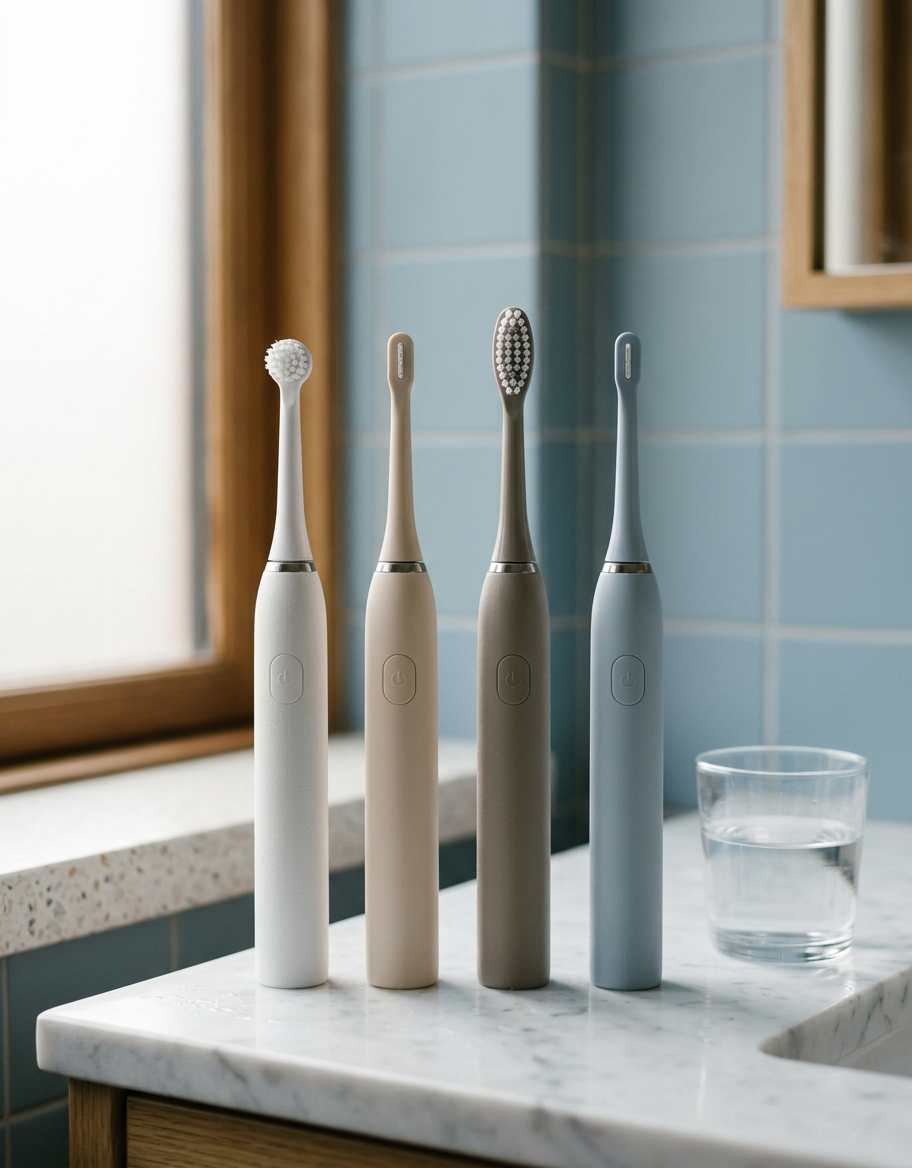
AI-generated editorial illustration; not a product or test photograph.
Short answer
The Oral-B Pro 1000 is our best electric toothbrush for most adults because its $49.94 listed price includes a pressure sensor, two-minute quadrant timer, and compatibility with widely available standard Oral-B heads. Choose the $39.99 Philips Sonicare 4100 if you prefer a slim sonic handle and gentler pressure feedback; choose the $69.99 Oral-B iO Series 3 for a visual smart-pressure alert, accepting pricier proprietary refills.
4
Product listings discussed; not hands-on tests
4/4
Discussed listings with a recorded price
$39.95–$69.99
Recorded listing price range; not a complete setup cost
Key takeaways
A pressure sensor matters more for gum protection than extra whitening, polishing, or intensity modes.
The $49.94 Oral-B Pro 1000 is the strongest all-around value because it combines pressure feedback with broad standard-head compatibility.
The $39.99 Philips Sonicare 4100 is the lower-priced pressure-sensor option for shoppers who prefer sonic brushing.
Brush-head spending can exceed the handle price over three years, so check refill availability and multipack pricing before buying.
A two-minute timer with 30-second quadrant cues is a practical baseline feature for more even brushing coverage.
Products discussed in this article
Editorial scores and recorded prices are reference points, not measurements of suitability for every use. Read each review's specifications and limitations.
The Oral-B Pro 1000 is our top pick for most adults. At a listed $49.94, it concentrates its value on the features that most affect everyday use: a built-in pressure sensor, a two-minute brushing timer, and 30-second quadrant pacing. Its round CrossAction head uses oscillating and pulsating movement, while the pressure system mechanically interrupts pulsations if you press too hard.
That emphasis is important. Extra modes can change the feel of a brushing session, but they do not automatically address aggressive scrubbing. Pressure feedback does. The Pro 1000 also uses standard Oral-B round heads rather than the newer proprietary iO fitting. That gives owners access to a broad range of compatible replacement heads and makes long-term budgeting more manageable.
There are trade-offs. The package includes one CrossAction head, so you should plan for refills soon after purchase. Its listed configuration is intentionally straightforward, making it a better fit for a buyer who wants essential safeguards than someone shopping for a screen, app features, or a large suite of programs.
Which electric toothbrush is best for gentle sonic brushing?
The Philips Sonicare 4100 is the best choice here for buyers who want a sonic-style brush with pressure feedback at a relatively low $39.99 listed price. Its slim, lightweight handle has a pressure sensor that produces a distinct vibrational pulse when excessive force is applied. It also includes a SmarTimer and QuadPacer for a two-minute routine divided into four 30-second sections.
Sonic and oscillating brushes use different head shapes and movement patterns. The Sonicare 4100 uses a longer, oval C2 brush head and high-frequency sonic action. The Oral-B Pro 1000 uses a compact round head with oscillation and pulsation. Neither format is automatically right for every mouth; head shape, comfort, and consistent technique are personal factors. What makes the 4100 a strong pick is that it does not make you sacrifice pressure feedback to reach a lower price tier.
The main limitation is running cost. Only one C2 head is included. Philips C2 three-packs are listed at $31.96, or about $10.65 per head, and a quarterly replacement schedule works out to roughly $128 over three years for 12 heads. That is far more than the handle itself.
The Oral-B iO Series 3 is worth considering if clear visual pressure feedback is your highest priority and you can accept higher refill costs. Its listed price is $69.99, placing it $20.05 above the Pro 1000. In return, it adds a 360-degree light ring that changes color when you exceed the recommended brushing force, plus three modes: Daily Clean, Sensitive, and Whitening.
The iO Series 3 uses Oral-B's round-head platform with micro-vibrations and includes a two-minute timer with 30-second quadrant prompts. The package also includes two brush heads and a travel case, which improves its immediate out-of-box value compared with single-head starter kits. For someone who tends to brush forcefully, a light-ring warning may be easier to notice than a more subtle change in handle behavior.
The long-term drawback is the iO head connection. iO brush heads are proprietary and are not compatible with the standard CrossAction-style heads used by the Pro 1000. Our review notes that iO refills carry a premium over older Oral-B standards, and using 12 quarterly replacement heads over three years will surpass the handle price.
In short, buy the iO Series 3 for its smart pressure feedback and included accessories, not simply because it offers more modes. See our complete Oral-B iO Series 3 review and our electric toothbrush buying tips for help weighing handle features against refill commitments.
Yes, but budget electric toothbrushes require a careful distinction between low initial cost and low ownership cost. The Aquasonic Black Series costs $39.95 and includes eight soft DuPont brush heads, a travel case, a timer, and a wireless charging base. With heads replaced every three to four months, eight included heads cover approximately 24 to 30 months of daily use. That is a meaningful advantage over a brush that includes only one head.
It is not, however, our overall winner. The Black Series lacks a dedicated pressure sensor. It has four settings—standard cleaning, softening, whitening, and gum stimulation—and a 30-second pacing timer, but settings are not a substitute for feedback when you are pressing too hard. Buyers who already use light pressure and want to minimize near-term refill purchases may reasonably prefer this package. People with gum sensitivity or a history of over-brushing should prioritize a pressure-sensing handle instead.
Replacement availability is the other question. Aquasonic uses proprietary head fittings, so future sourcing may be less flexible than it is with standard Oral-B heads. Before choosing any value kit, identify its replacement head type and look at current multipack pricing.
A pressure sensor is hardware that alerts you, slows the action, or otherwise responds when you push the brush too firmly against teeth and gums. It is different from a sensitive mode. A sensitive mode changes a programmed operating level; it cannot know whether your hand is applying too much force at a particular spot.
Among our leading picks, the feedback style differs. The Oral-B Pro 1000 mechanically interrupts pulsations when pressure is excessive. The Philips Sonicare 4100 delivers a distinct vibrational pulse. The Oral-B iO Series 3 changes the color of its light ring. Each approach gives the user a cue to ease up, which is why these models rank ahead of similarly priced brushes that primarily add modes or bundled heads.
Technique still matters. Let the powered head do the cleaning rather than scrubbing back and forth as with a manual brush. Move methodically along the outer, inner, and chewing surfaces, spending equal time in each quadrant. A timer supports that routine, but it cannot compensate for missed surfaces or excessive force.
Pressure sensors are not a diagnosis or treatment for gum problems. If brushing is painful, gums bleed persistently, or you are unsure which bristle firmness is appropriate, seek individualized advice from a dental professional. For common errors to avoid, see electric toothbrush mistakes, plus our explainer on whether electric toothbrushes are better.
How much do replacement brush heads cost over three years?
Replacement heads are the cost most shoppers underestimate. A common replacement schedule is every three months, which means four heads a year and 12 heads over three years. The best handle on day one is not necessarily the best value if its refills are unusually expensive or difficult to source.
The math favors standard Oral-B compatibility among our top picks. The official Oral-B CrossAction eight-pack is listed at $26.14, or approximately $3.27 per head. At that price, 12 heads cost about $39.21 over three years, although actual purchases and current prices can vary. The four-pack is listed at $18.40, or about $4.60 per head, showing why larger packs generally improve unit economics.
By comparison, Philips Sonicare C2 heads are listed at $31.96 for three, or roughly $10.65 each. Four per year equals about $42.60 annually and about $128 across three years. The iO Series 3 uses a proprietary iO head, and our review identifies those replacements as a premium ongoing expense; confirm current multipack prices before buying.
The Aquasonic package defers, rather than eliminates, this issue by including eight heads. Its proprietary fit means you should verify that replacement stock is available when the bundle runs out. Consult our oral care FAQ for more ownership questions and the CrossAction eight-pack review for the specific standard-Oral-B refill math.
What features should you skip when buying an electric toothbrush?
Skip features that do not solve a problem you actually have. Multiple cleaning modes, travel cases, Bluetooth connectivity, and whitening labels can be useful conveniences, but they should come after pressure feedback, a timer, comfortable head geometry, and a sustainable refill plan. The Pro 1000 demonstrates the principle well: it keeps the feature set simple while retaining pressure sensing and pacing.
Do not choose a brush solely because it bundles many heads, either. The Aquasonic Black Series earns value points because eight heads postpone new purchases, but its lack of a pressure sensor remains a material safety limitation. Conversely, do not dismiss a one-head starter kit without calculating the refill total. The lower-priced Sonicare 4100 offers a pressure sensor but has a substantially higher documented OEM head cost.
Also avoid treating a water flosser, toothbrush sanitizer, tongue scraper, or replacement-head pack as a substitute for a complete electric toothbrush. Those products can have roles in an oral-care routine, but they do not meet the same need as a powered brush handle. If you want a water flosser as well, reservoir capacity is important: a larger tank is more likely to complete a full session without a refill.
Finally, verify exact model packaging, included heads, charging requirements, and compatibility at checkout. Listings and colors can have different configurations. Start with our best electric toothbrushes hub for an updated shortlist and use the manufacturer instructions for model-specific charging, cleaning, and storage guidance.
Confirm that the exact handle includes an active pressure sensor or pressure alert.
Check whether the brush has a two-minute timer and 30-second quadrant pacing.
Identify the head fitting: standard Oral-B, Sonicare click-on, iO proprietary, or another proprietary design.
Calculate the likely cost of 12 replacement heads, based on a three-year quarterly schedule.
Choose a head shape that feels practical for your back teeth: compact round or longer oval.
Verify how many heads, charging accessories, and travel items are included in the exact package.
Read the manufacturer instructions for charging, cleaning, waterproof-use limits, and replacement parts.
Frequently asked questions
Is an electric toothbrush with a pressure sensor worth it?
For many adults, yes. A pressure sensor responds when brushing force is excessive, whereas a timer simply tracks time and a sensitive mode only changes the programmed intensity. The Oral-B Pro 1000, Philips Sonicare 4100, and Oral-B iO Series 3 all include pressure feedback in different forms.
Which is better: Oral-B or Sonicare?
Neither is universally better. Oral-B models in this guide use compact round heads with oscillating and pulsating action, while the Sonicare 4100 uses an oval sonic head. The Pro 1000 has lower documented official refill costs in bulk, while the Sonicare 4100 costs less upfront and includes pressure feedback.
How often should I replace an electric toothbrush head?
A standard guideline is every three months. That works out to four heads per year or about 12 across three years. Replace sooner if bristles are visibly worn or follow the specific head maker's instructions. Regular replacement is a major part of an electric toothbrush's long-term cost.
Are expensive electric toothbrushes better?
Not necessarily. The $49.94 Oral-B Pro 1000 includes the key pressure-sensor and timer features without a premium price. More expensive models may add visual feedback, cases, more heads, or more modes, but assess whether those additions justify both the higher handle price and the replacement-head ecosystem.
Does the Aquasonic Black Series have a pressure sensor?
No dedicated pressure sensor is listed for the $39.95 Aquasonic Black Series. It includes four modes, a two-minute timer, wireless charging, a travel case, and eight brush heads, but users must regulate brushing force themselves. Its bundle is best viewed as a cost-saving feature rather than gum-pressure protection.
Why do electric toothbrush replacement heads cost so much?
Brush heads are recurring consumables, while the handle is a one-time purchase. For example, the listed Philips Sonicare C2 three-pack costs $31.96, about $10.65 per head. At quarterly changes, that is roughly $128 for 12 heads over three years, exceeding the price of the Sonicare 4100 handle.
Amazon links are affiliate links; we may earn a commission at no cost to you.
Sources and limits
This page summarizes our research reviews of Amazon listings, listed specifications and captured buyer ratings. It is not a hands-on test. Scores are editorial assessments, not measured performance; prices are recorded snapshots and may change. A category can include both main products and accessories, so its overall price range is not the cost of a complete setup.
Most recent product record update: October 3, 2026. Individual records may be older; this is not a verification date for every claim.
Choose the product type first. These groups require a match in the listing title; an import search term alone is not enough. Scores rank our recorded research assessments within each group, not independently measured performance.
Proprietary iO refill heads carry a cost premium over older standards
What to verify before choosing
Pressure sensors protect gums more than extra modes do.
Replacement head cost over three years often exceeds the handle.
Tank size decides whether a flosser finishes one session.
If a specification, certification or compatibility detail is absent, mark it as unknown and ask the seller or manufacturer. Do not substitute a star rating, an editorial score or a different model's specification.


 Oral-B Pro 1000 Rechargeable Electric Toothbrush, Pink